

For pallet handling by freight elevator, measure the loaded assembly in its travelling condition and record how it will move through the building. The pallet footprint alone is not enough. Goods, protective packaging and carrier details can change the outside dimensions, while the handling method changes what crosses the entrance and what travels inside the car.
A useful enquiry therefore combines a load record with a route drawing. This FEIYA Elevator guide explains how a warehouse or factory team can prepare those records before discussing a proposal. The aim is to give purchasing, operations and technical reviewers the same description of the job, rather than leaving each team to imagine a different pallet movement.
Identify the load before taking measurements
Give each load arrangement a clear reference, such as a product group, packaging drawing or internal load number. Record whether the item is a routine shipment, a seasonal batch or an occasional replacement machine. Keep the measurement date and the person or department that supplied the information with the record. This makes later clarification easier when a quotation refers to a different packaging revision.
Do not assume that all products using one pallet type create the same load. A stack of cartons, a wrapped machine and a stillage may project beyond the carrier in different ways. Group arrangements only when the relevant outside dimensions, weight and handling restrictions are understood. Where they differ, separate records are usually clearer than one average entry.
Ask operations to identify the load that is hardest to manoeuvre as well as the heaviest one. They may be different assemblies. A long package can govern access even when another item governs the weight discussion. Recording both at the start helps the supplier understand which conditions the proposal must address.
Measure the complete packed envelope
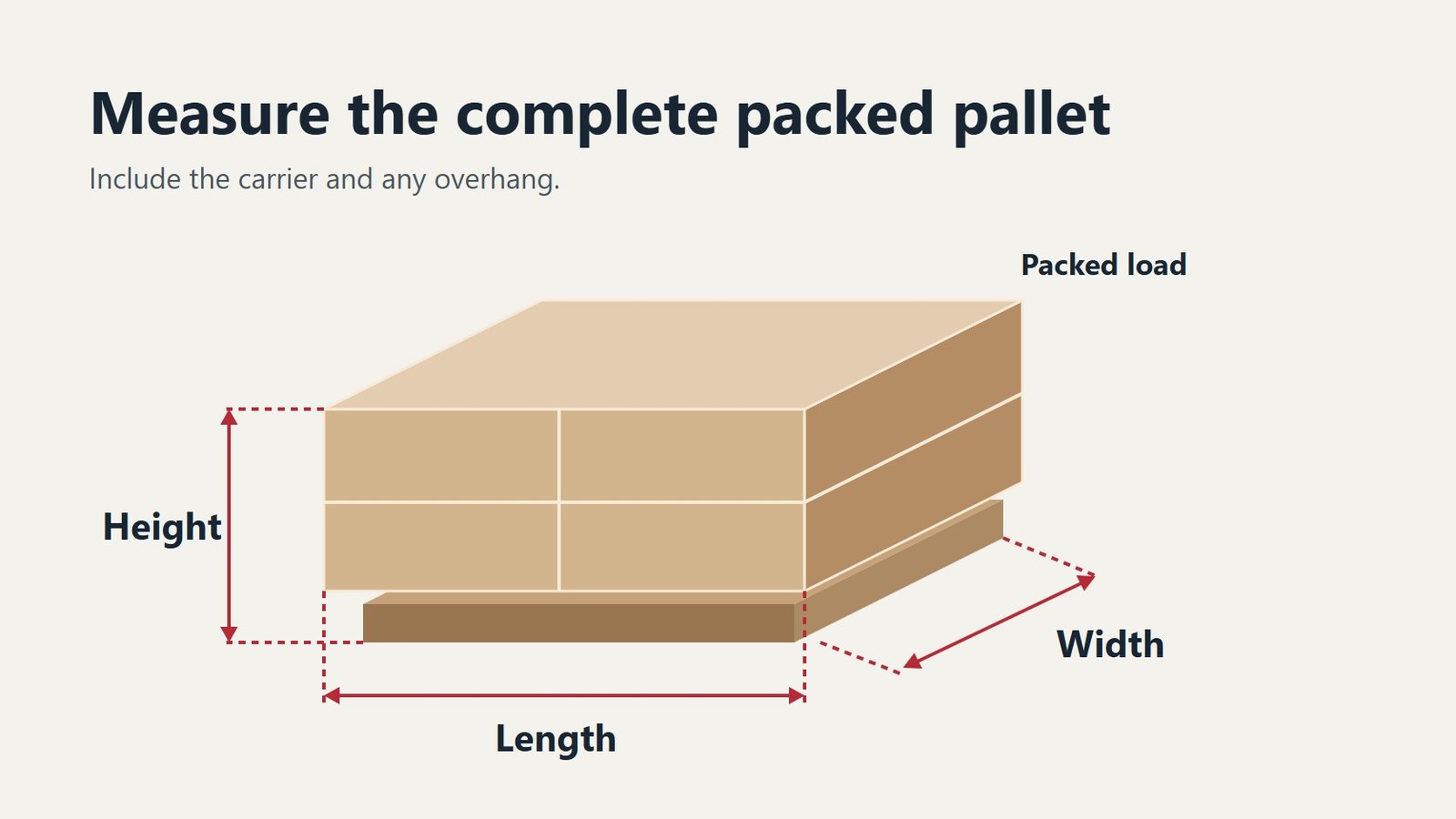
Measure the outermost length, width and height of the loaded assembly. Include wrapping, corner protection, securing materials, projecting feet and packaging overhang. Where the load is irregular, show the projection on a sketch rather than giving dimensions that describe only its main body. Identify which side faces the elevator during the proposed movement.
Include the pallet or transport base in the height measurement. If the supplier's product drawing excludes packaging, obtain the packing information separately. A catalogue size for the unpacked product should not silently become the travelling envelope used for the elevator review. Mark preliminary estimates clearly so they remain visible until confirmed.
Also record restrictions on orientation. Some goods may need to stay upright or face a particular direction for unloading. Do not assume that an item can be tilted, rotated or dismantled simply because that would make the layout easier. The team responsible for the goods should confirm any proposed change to their transport condition.
Add the weight that accompanies the goods
The goods weight may be only one part of the travelling load. Record the packaging, pallet, stillage or trolley that accompanies it. Describe any handling equipment entering the car, including equipment that enters temporarily during loading. If people are intended to travel with the goods, state that requirement for the proposed elevator type and permitted use to be reviewed.
Identify whether a weight was measured, supplied in shipping documents or estimated. If separate components are added together, keep the breakdown with the total so it can be checked. When a component changes, the team can then update the relevant entry instead of starting again or relying on an unexplained figure copied between documents.
Record routine batches separately from the maximum planned trip. Avoid treating the usual weight as a statement of every future loading condition. The freight elevator capacity guide covers the broader capacity discussion; the measurement record provides the practical information needed to have that discussion for your own goods.
Describe the carrier and transfer method
For a trolley, include the frame, handles and attached equipment in the dimensional record. Note whether a handle remains in its operating position while entering the car. Record the carrier's movement restrictions and how the operator intends to position it. A drawing of goods standing alone does not describe the space needed to move the loaded carrier.
For pallet transfers, explain what stays outside, what enters temporarily and what travels to the destination. If a forklift is involved, describe its intended movement explicitly and provide the relevant truck and load information. A pallet fitting through the doorway does not establish that a truck can enter or travel inside. The forklift loading guide sets out the information for that separate review.
Show how the load is supported. Available skid, foot, wheel or axle information helps the supplier identify the floor and threshold checks required for the proposal. Do not replace the contact arrangement with a total weight divided by the full cabin area. Keep the support information connected to the handling method actually being proposed.
Use one record for purchasing and technical review
The following fields can form a simple load register. Their purpose is to expose assumptions and make a consistent enquiry, not to approve a loading arrangement or prescribe a standard operating clearance.
| Record field | Information to enter | Why it matters |
|---|---|---|
| Load reference | Product, packaging revision and measurement date | Identifies which assembly the proposal covers |
| Packed envelope | Outermost dimensions and orientation | Connects the goods to the access and interior review |
| Weight breakdown | Goods, packaging, carrier and other intended travelling items | Makes the total traceable and easier to update |
| Handling method | What remains outside, enters temporarily or travels inside | Defines the proposed transfer task |
| Support arrangement | Available skid, foot, wheel and axle details | Supports local floor and entrance assessment |
| Route reference | Landing drawings and restrictive locations | Links the load to the building conditions |
| Open questions | Missing figures, responsible contact and confirmation status | Prevents an estimate from becoming an unnoticed assumption |
Use the same register revision when requesting competing quotations. If one supplier asks for more information, consider whether that information should also be issued to the others. This keeps the comparison focused on responses to a shared brief. Preserve the questions and answers with the proposal so the reasoning remains available when the order is reviewed later.

Trace the route at each landing
Start at the position where the loaded pallet waits. Mark how it approaches the elevator, whether it needs to turn and how it will leave at the destination. Include restrictive corners, columns and fixed obstructions. A measurement taken at the widest part of a corridor may say little about the location where the load actually needs to change direction.
Show the relevant movement on a plan using the complete packed envelope and carrier information. For a rigid assembly, the corners during a turn matter as well as its starting and finishing position. Where the available information is incomplete, identify the need for measurement or a site survey rather than filling the gap with an assumed clearance.
Repeat this check for the destinations that differ. Same-side and through access create different movement patterns, but both need to be considered with the landing layouts. A convenient entry at the dispatch floor does not establish that the pallet can be withdrawn at the receiving floor. The building route is part of the task, not an attachment to consider after choosing a car.
Connect the load record to the proposed drawings
Ask the supplier to identify the finished clear opening and usable car dimensions on the proposed drawing. Keep those separate from the builder's opening and shaft dimensions. Check that the dimensions being compared refer to the spaces through which the loaded assembly will actually pass and stand. Protective fittings and agreed interior features should be considered in the usable-space discussion.
The packed-pallet illustration shows where to take the outer measurements. Carry the dimensions from your own load record into the access and interior review, then use the project drawings to check the proposed movement and loading arrangement.
When reviewing a proposal, note which load register and route drawing revisions it uses. If a different carrier or entry direction is proposed, ask for the resulting arrangement to be shown. The shaft and cabin planning guide provides more context for reading the different dimensions before the project team approves them.
Keep changes visible after the enquiry
Packaging changes can alter the travelling envelope even when the product remains the same. A new transport base, a different trolley or extra protective material can affect dimensions and weight. Have the responsible team update the register and identify which approved assumptions need to be reopened. A familiar product name is not sufficient evidence that its new packed arrangement is unchanged.
Keep the reviewed load and handling information available to the people who will use the equipment. Where technical review establishes restrictions, carry them into the relevant project and operating documentation. Agree who will coordinate changes rather than leaving the purchasing record disconnected from the actual transfer method used on site.
Do not treat an occasional exception as covered simply because normal deliveries work. Record the exceptional movement and ask the relevant parties to review it before planning around it. A consistent record helps the team identify what has already been assessed and what requires a new discussion, without relying on memory or an old photograph.
Questions buyers often ask
Can I use the nominal pallet size in the enquiry?
Use it to identify the carrier, then measure the loaded assembly. Goods and packaging can extend beyond the pallet footprint. Include those projections, total height and orientation restrictions so the supplier reviews the actual travelling envelope.
Must every load be placed on a separate sheet?
Use the level of detail needed to distinguish relevant arrangements. A register can group genuinely similar loads, while separate sketches explain unusual projections or movement restrictions. Keep the largest dimensions and heaviest planned trip visible even when routine products are grouped together.
Can the supplier select the elevator from photographs alone?
Photographs help explain the goods and location, but perspective does not provide reliable dimensions. Send the measured envelope, weight breakdown, carrier details and route drawings as well. Ask which missing measurements require confirmation before a preliminary proposal becomes an order arrangement.
Prepare your pallet-handling enquiry with FEIYA Elevator
Send the load register, available site drawings and intended transfer sequence when discussing project-specific elevator solutions. Highlight the most restrictive landing, uncertain figures and any occasional load that differs from daily movements. Include the project location and the contacts responsible for goods, building and installation coordination.
Contact FEIYA Elevator with that shared brief. Connecting the entire load to its route gives the purchasing and technical teams a clearer basis for reviewing the proposed arrangement and keeping later changes under control.